Most watch buying guides begin by assuming you want a hobby. Winding, setting, regulating, servicing, parking the thing on a charger or a window sill: all of that is part of the appeal for plenty of people, and none of it is the point here. This guide is for the other reader, the one who wants to strap a watch on and have it be right, indefinitely, without being asked for anything.
The title is a constraint, and it is stricter than it looks. “Never wind” rules out every mechanical watch on the site. The Hamilton Khaki Field Mechanical is a lovely thing with an 80-hour reserve, but it is hand-wound, and a reserve is just a countdown to the next time you have to turn the crown. The Tissot Powermatic 80 offers 80 hours, the Swatch Sistem51 offers 90, the Rolex Submariner 124060 offers 70. Those are generous numbers, and they are still numbers. An automatic is better at looking after itself than a hand-wound watch, but it is still a mechanism that stops if you leave it in a drawer, and the sheet for each one lists a reserve because the reserve exists.
“Never charge” is the half that catches people out, because solar quartz sounds like the answer. It is a good answer for many buyers. The Casio G-Shock GW-M5610U is Tough Solar with Multi-Band 6 radio sync, and the inventory describes months of running from a full charge. The Tank Must de Cartier uses a SolarBeat photovoltaic movement, with about 24 months of running per full charge on the current version. Both are excellent at needing nothing most of the time. But both have the word charge somewhere in their spec sheets, which means there is a condition under which they will need light, and a watch that lives in a sock drawer or under a long cuff is exactly the case where that condition arrives. We left them out of this guide on purpose. They belong in a different one.
That leaves battery quartz: a cell goes in, the watch runs, and the cell comes out some years later. There is no reserve, no light requirement and no moving rotor. What is left to judge is how long the cell is rated to last, how much watch you get around it, and what Casio or Bulova actually put in writing. That last part is where this category gets interesting, and it is where a spec sheet is most useful.
Reading a battery-quartz spec sheet
For a mechanical watch you read the reserve, the beat rate and the jewel count. For this category, there are fewer lines and each one carries more weight.
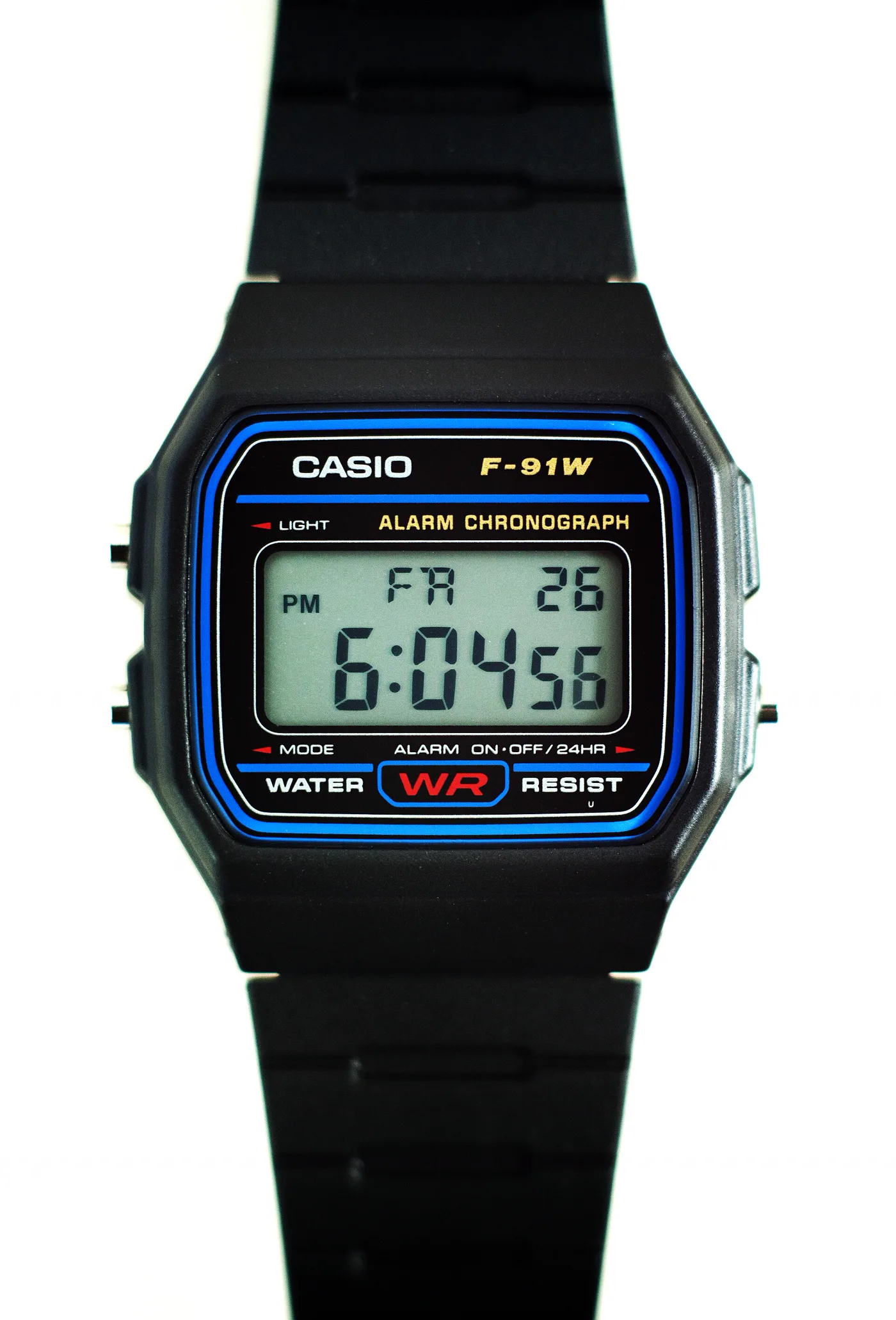
Start with the battery line. It is the one number that tells you how often you will touch the watch. The Casio F-91W is rated for about 7 years on a single CR2016. The Casio G-Shock GA-2100 is rated for about 3 years on two SR726W cells. Those are the manufacturer’s figures, taken from Casio’s own pages and its Module 5611 operation guide, and they are rated lives, not guarantees. The Bulova Lunar Pilot is the awkward one: Bulova does not publish a battery life figure for this reference, and the inventory says so plainly. We will not guess. If a number matters to you, ask Bulova before you buy, because we cannot give it to you.
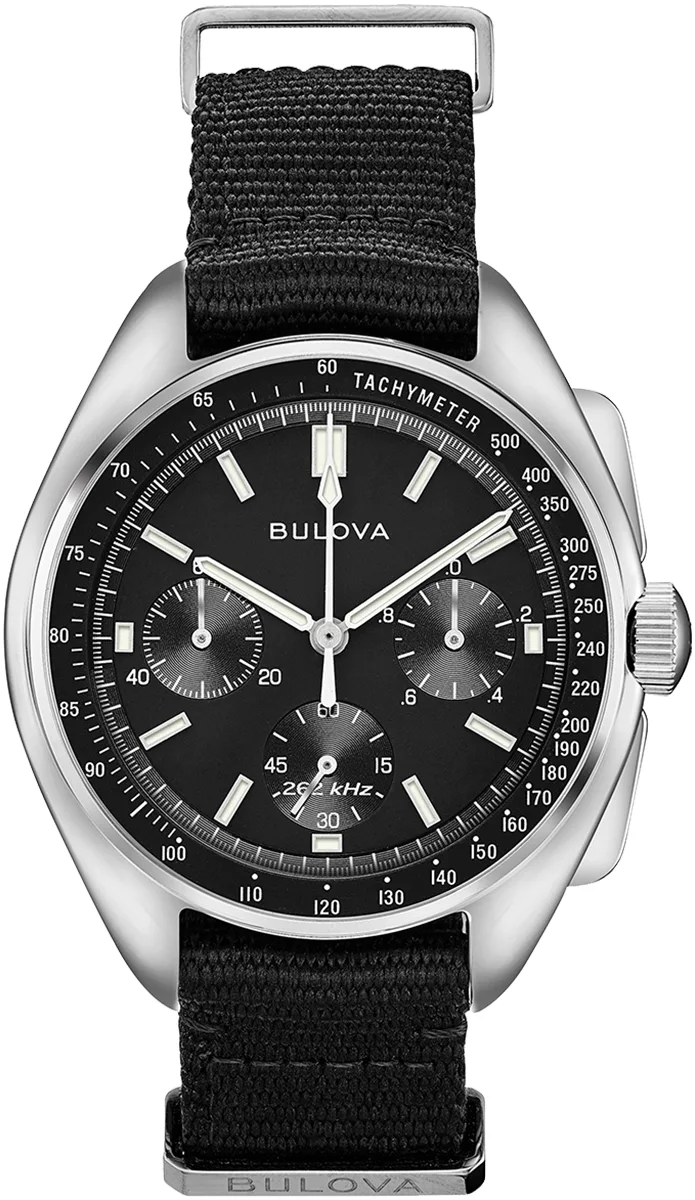
Then read the movement line for what it says about timekeeping. For the GA-2100, Casio’s operation guide gives accuracy of about 15 seconds a month for Module 5611. For the others, the inventory carries no accuracy figure, and so we print none. The Bulova movement is named as High Performance Quartz at 262 kHz; that frequency is the printed spec, and nothing in our source set turns it into a claim about seconds per month, so we leave it there.
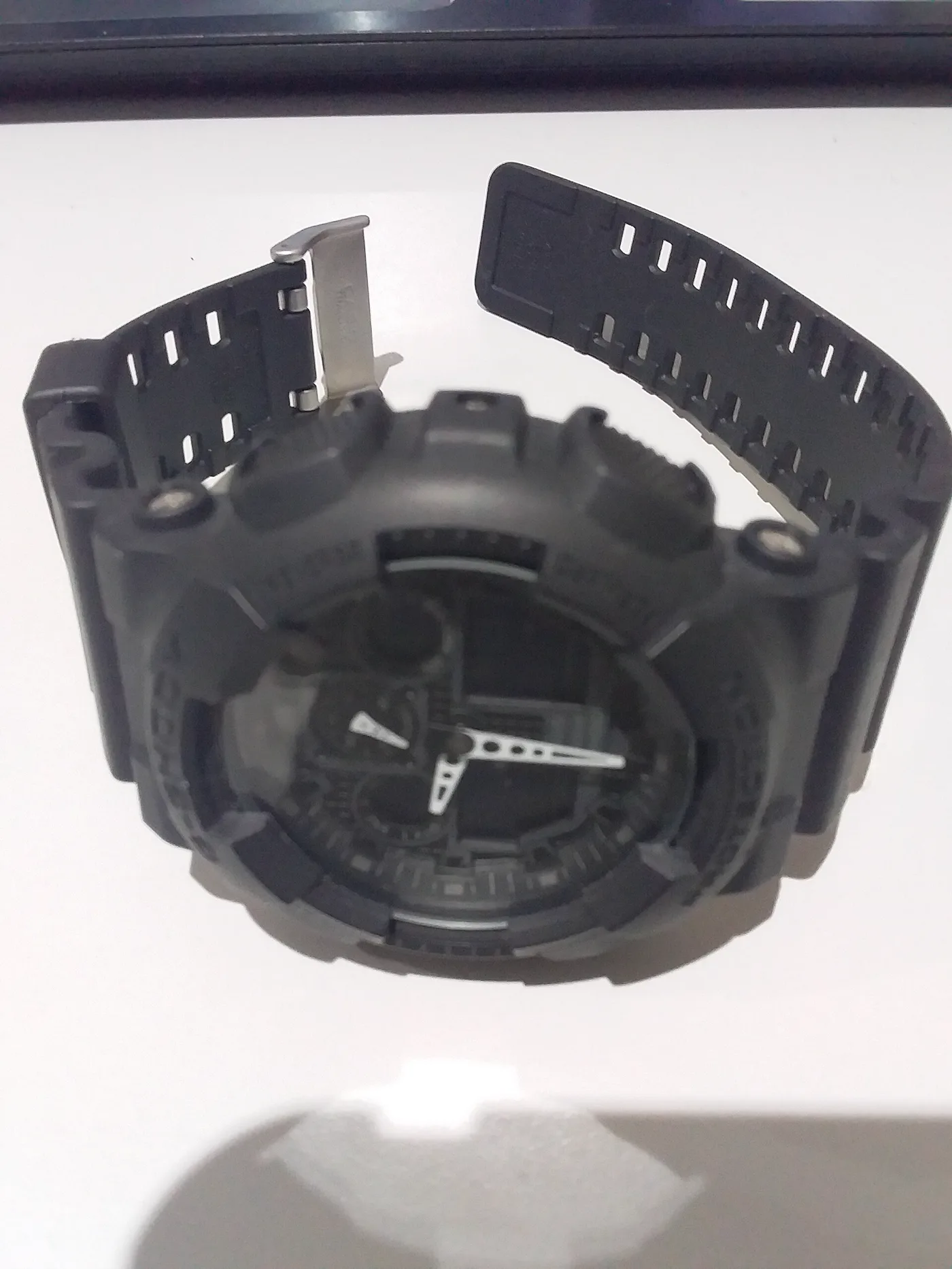
Then read what is wrapped around the movement. A quartz watch is only as durable and as pleasant as its case, and here the picks diverge sharply. The GA-2100 has a carbon-fiber-reinforced resin case and a 200m rating. The Lunar Pilot has a sapphire crystal with anti-reflective coating and only 50m. The F-91W has a 30m rating, a resin strap with a fixed buckle, and a crystal that Casio does not clearly name. None of these is a flaw in the sense of a defect. They are the trade-offs, and each one is printed in the pick it belongs to.
Finally, read the dimensions, because quartz cases are not constrained by movement size the way mechanical ones are. That freedom shows up in the numbers: a 35.2mm F-91W at 8.5mm thick, and a 45.4mm GA-2100 at 11.8mm thick with a 48.5mm lug to lug. That is a ten-millimetre spread in diameter inside a single category, so check the wrist before you check the price.
What each pick buys
The GA-2100 ranks first because it is the most complete answer to the brief. It has a published battery life, a published accuracy figure, a published thickness, lug to lug and water resistance, and a HypeScore of 80, the highest in this guide. Its battery life is shorter than the F-91W’s, at 3 years against 7, but two cells in a 200m case is a fair trade for the size of the thing. It is also the largest watch here, and it is a resin G-Shock, which is either what you want or it is not.
The Lunar Pilot ranks second, and it is the one for a reader who needs a quartz watch to look like a watch. It is a six-hand chronograph with a sapphire crystal and a black NATO strap, and it carries a heritage line from Bulova about a chronograph worn on the moon on August 2, 1971. That is Bulova’s claim as published on its collection page, and it is cited only as heritage. The price band runs from $375 to $595, which is wide, and you should check where in it a given seller sits. Its weakness for this guide is the missing battery figure, and its 50m rating is the lowest of the three outside the F-91W’s 30m. We placed it above the F-91W because it has a sapphire crystal, a chronograph and a higher score, and below the GA-2100 because the GA-2100 tells you more about itself.
The F-91W ranks third on score and first on one line. About 7 years from a single CR2016 is the longest figure in this guide, and at $18 to $25 it is the cheapest watch on the site. What the inventory does support: it is 35.2mm wide, 8.5mm thick, launched in June 1989, and its feature list is a 1/100-second stopwatch, a daily alarm, an hourly time signal and an auto-calendar. If you have small wrists and want a watch you can forget, it is the smallest on this list by a wide margin.
What to skip, and why
Skip the solar watches if your reason for reading this is that you do not want a light requirement. They are a good product and a different one. If your watch will spend months in a drawer, the conditions under which they are rated to run are not the conditions you will give them.
Skip any watch on this site that lists a power reserve in hours. The Swatch Sistem51 at 90 hours and the Tissot at 80 are the best of them, and a reserve that long is a real convenience, but it is still a reserve. You asked for never.
Skip the Bulova if the battery figure is the thing you are buying. It is a good-looking, sapphire-crystal chronograph, but the number you most need is the one Bulova leaves out. That is not a reason to rule it out for everyone, only for the reader who decides on the printed battery life.
Skip the F-91W if you want a thicker case, a crystal you can name, or more than 30m on the sheet. Its virtue is how little it claims, and it should not be asked to do more than that.
How to choose among the three
If you want the most information on the sheet and the most robust case, buy the GA-2100. It is the highest scoring pick and it publishes the most. Mind the 45.4mm width and the slide-lever band mount, which limits your strap choices.
If you want a quartz watch that reads like a proper watch, buy the Lunar Pilot, and accept that the battery life is unstated. It is the only chronograph here and the only one with a sapphire crystal, but it is 45mm as well, so it is not the answer for a small wrist.
If you want the smallest, lightest and longest-lived battery, buy the F-91W, and accept the resin and the 30m. It is the cheapest watch on the site and one of the most honest.
All three are quartz, and that is what makes them quiet purchases. None of them has a rotor, a mainspring you wind, a solar cell, or a service interval that appears on its spec sheet. What each one has is a battery, and a date, a few years out, when you will need to change it. That is the whole relationship. If you are comfortable with that, you are in the right guide.
Why only three
This guide launches with three picks and plans to grow to five. We would rather print three watches whose battery claims we can cite than pad the page with watches that quietly need winding or light. Every figure above comes from the inventory, and where the inventory is silent, we have said so. A watch guide that never invents a fact should be most careful exactly where the brief is simplest, because “needs nothing” is a claim, and a claim needs a source. The F-91W has one, and so does the GA-2100. The Lunar Pilot has a movement and a crystal and a heritage line, and an honest gap where the battery life should be.
As the inventory grows, this list will too. If a maker publishes a battery figure for a quartz watch we already cover, or a new battery-quartz reference joins the atlas with its numbers attached, it will be added here with the same rule applied: the catch printed underneath, and nothing claimed that the sheet cannot show.