The Integrated Steel Question
Gerald Genta priced the first integrated-steel sports watch above a gold Patek in 1972. Fifty-four years later the same silhouette starts under $400, tops out under $1,400 before the real money begins, and the gap between those two numbers is the whole story.
In 1972, Gerald Genta drew a steel sports watch with a bracelet welded into the case and Audemars Piguet priced it at 3,300 Swiss francs, more than a gold Patek Philippe dress watch was asking that year, and more than ten times what Rolex wanted for a Submariner. Steel had never been the expensive material in a watch before. Genta’s whole bet was that a shape could be worth more than a metal. Today that exact reference, in that exact metal, trades on the secondary market for roughly $51,600. The bet paid off so completely that the industry spent the next five decades arguing about who gets to borrow the silhouette, and at what price a borrowed silhouette stops being an insult and starts being an honest watch on its own terms.
That argument is what the Tissot PRX versus Christopher Ward The Twelve comparison is actually about, whether the page says so or not. It reads like a spec duel: movement here, power reserve there, a bronze mark next to whichever side wins the row. Underneath the table it is a referendum on how much of Genta’s idea a watch under $2,000 can responsibly claim to be selling you, and the honest answer changes depending on which of the two watches, or a third one the comparison does not even mention, you are holding.
Every road in this category still runs through 1972
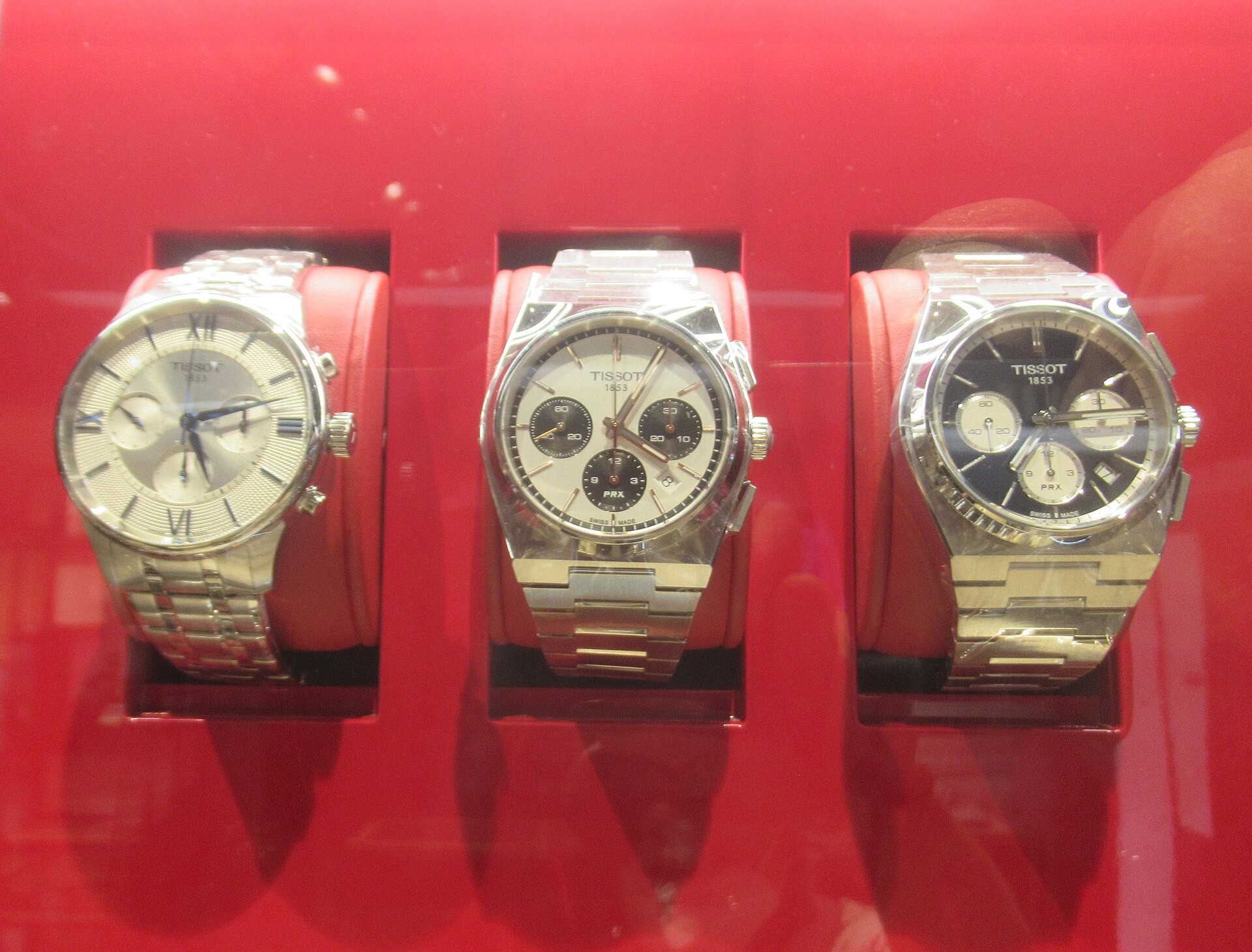
Strip the marketing language off any “integrated bracelet” watch under $2,000 and you find the same three decisions Genta made: a case that flows into the bracelet with no lug gap, a bracelet built as part of the watch rather than a strap you swap out, and a bezel treatment that turns the case itself into the decoration. None of that requires the vocabulary. It requires the shape. The Tissot PRX’s own Atlas entry does not mention Genta once, and it does not need to: the 40mm case with no separate lugs and no standard lug width tells you everything his drawing meant to say, at roughly a seventy-fifth of the price of the watch that said it first.
This matters because it sets the actual question honestly. Nobody buying a $700 PRX or a $1,300 Twelve is confused about whether they are holding a Royal Oak. They are buying into a design language a Genta original made famous and then priced out of reach for almost everyone who might have wanted it. The category under $2,000 exists because that pricing-out was never really about the steel. It was about scarcity, heritage, and a waiting list Audemars Piguet has spent fifty years cultivating on purpose. A movement, a bracelet and a case shape do not carry a waiting list with them when a different company builds them, and that is the entire opening this category lives inside.
The PRX proved the floor could hold
Tissot’s argument, made since 2021 and unchanged since, is that the floor does not have to be cheap-feeling. The PRX runs a Powermatic 80 at a slow 21,600 vph to bank a genuine 80-hour reserve, inside a 40mm case that measures 10.9mm through the middle, all for $650 to $725 street. Eighty hours means the watch survives a full weekend in the drawer and still starts on Monday without a reset. That single number is the PRX’s whole pitch, and it is a real one.
What the PRX does not pretend to do is finish the case and bracelet at a level that would embarrass the original. Its own Atlas entry calls the clasp’s missing micro-adjust “the first thing I would change,” and that is not a small complaint dressed up as a minor one. An integrated bracelet with no way to fine-tune the fit is a bracelet you either get lucky with or live with slightly wrong every single day, because you cannot swap it for a different strap the way you would on almost any other watch. Tissot took the trade that makes the spec sheet look best and left the trade that shows up on your wrist at 6pm when it swelled a half size since morning.
The Twelve is the argument that the floor wasn’t the ceiling
Christopher Ward’s answer is not a cheaper watch. It is a more finished one, sold direct with no dealer waiting list, at roughly double the PRX’s money. The Twelve measures 9.95mm through the case against the PRX’s 10.9mm, a difference under a millimeter that reads as trivial on paper and does not feel trivial under a cuff, and it backs that up with a toolless three-position micro-adjust clasp, the exact feature the PRX’s own writeup names as its weak point. The compare page’s own framing puts it plainly: the Twelve wins the three rows you feel with the watch in your hand.
The cost of that improvement is not just the extra $500 to $650. The Twelve’s Sellita SW200-1 beats faster, at 28,800 vph, but banks only 38 hours against the PRX’s 80, which means it needs a wind or a winder after a long weekend where the PRX would not. That is a real trade, not a rounding error, and Christopher Ward does not hide it any more than Tissot hides its clasp. Buying the Twelve means deciding that a thinner case and an adjustable clasp are worth giving back forty-two hours of reserve and doubling the price. It is a defensible decision. It is not a free one.
A third watch the duel leaves out, and it belongs in the room
The PRX-versus-Twelve framing implies the category starts around $650. It does not. Citizen’s Tsuyosa runs the same integrated-bracelet idea, in the same 40mm tonneau case family, for $371 to $495 street, on Citizen’s own Caliber 8210 automatic, and its own Atlas entry does invoke Genta directly, calling it the reason “a Genta silhouette now shows up on wrists that never went near an auction house.” That is not a coincidence of language. It is the same design argument the PRX and the Twelve are making, at a price low enough that the watch stops asking to be taken as seriously as either of them.
The Tsuyosa’s catch is not subtle. Citizen does not publish a thickness or lug-to-lug for the case at all, the water resistance is 50 meters, a rain-and-pool number rather than a dive number, and the movement carries a loose accuracy claim next to the PRX’s and Twelve’s tighter Swiss specifications. What it proves, sitting next to the other two, is that the category is not one price point with two competing philosophies. It is three, stacked: buy in for under $500 and accept an unpublished case thickness, buy in for under $750 and get a slow-beat movement with a genuinely excellent reserve, or buy in past $1,100 and pay specifically for the millimeter and the clasp. Each rung states its own catch. None of them pretends to be the rung above it.
What $2,000 still will not buy you
Here is the trade none of these three watches makes, because none of them can. Audemars Piguet’s own Royal Oak in steel trades today at roughly $51,600 on the secondary market, a figure that has nothing to do with a movement spec sheet and everything to do with scarcity, brand heritage, and resale demand built over five decades. No comparison table with the PRX and the Twelve in it, and no third watch you add to it, closes that gap, because the gap was never made of case thickness or power reserve to begin with. It was made of a waiting list, and a waiting list is not a component a $700 or a $1,300 watch can buy its way into.
That is not a knock on either watch. It is the honest boundary a reader deciding between them deserves to hear stated plainly rather than implied. The PRX and the Twelve are not cut-price Royal Oaks failing to be the real thing. They are their own answers to the same design question Genta asked in 1972, built by companies with no interest in pretending otherwise, sold at prices that put a genuinely well-specified integrated-steel watch within reach of a buyer who will never see the inside of an authorized-dealer boutique for the original. What separates good judgment from bad judgment in this category is knowing exactly which of those two things you are buying, and neither Tissot nor Christopher Ward asks you to guess.
So which one is the right buy
I would buy the Tsuyosa first, for anyone deciding whether they even like wearing an integrated bracelet, because under $500 is a cheap enough seat to walk away from if the answer is no. Past that decision, the compare page’s own verdict is the one I would defend at a dinner table: the PRX if the 80-hour reserve and the lower price matter more to your actual week than a millimeter and a clasp, the Twelve if you have already handled the Tissot’s clasp problem and decided you cannot live with it. Both are honest watches. Neither one is lying to you about what it is, which, fifty-four years into this argument, is more than the category could always say for itself.
Frequently asked questions
What does “integrated bracelet” actually mean on a watch?
It means the bracelet is built as part of the case rather than attached to separate lugs, so there is no gap where a strap would normally connect and no standard lug width to swap it for something else. Every watch discussed here, the Tissot PRX, Christopher Ward’s The Twelve, and the Citizen Tsuyosa, states plainly that it has no standard lug width for exactly this reason.
Is the Tissot PRX or Christopher Ward The Twelve the better buy?
Neither one is objectively better; they are different trades. The PRX gives you an 80-hour power reserve and roughly half the price; The Twelve gives you a thinner case, a toolless micro-adjust clasp, and finishing the PRX does not attempt, for about double the money. Buy the PRX if the reserve and the price matter more; buy the Twelve if the details are the point.
Why do these watches look like an Audemars Piguet Royal Oak?
Because Gerald Genta’s 1972 Royal Oak established the template the whole category still uses: an octagonal or tonneau case flowing directly into an integrated steel bracelet with no visible lug gap. That design launched at 3,300 Swiss francs, priced above a gold Patek Philippe dress watch of the era, and the shape has been reinterpreted at every price point below it ever since.
Is there a genuinely good integrated-steel watch under $500?
Yes. The Citizen Tsuyosa runs $371 to $495 street on Citizen’s own Caliber 8210 automatic in the same 40mm case family as the pricier options here. The catch is real: Citizen does not publish a case thickness or lug-to-lug, water resistance is 50 meters rather than a dive rating, and the accuracy claim is looser than the Swiss movements above it.
Does spending more in this category get you closer to an actual Royal Oak?
No, and it should not be sold to you that way. Audemars Piguet’s own steel Royal Oak trades at roughly $51,600 today, a gap built from scarcity and heritage that no amount of spending under $2,000 closes. The PRX and The Twelve are honest watches making their own case, not discounted versions of someone else’s.
Jules Marlowe WatchHypeHQ
- Time and Watches: History of the Audemars Piguet Royal Oak · Fetched directly today. States the Royal Oak launched in 1972 at the Basel Swiss Watch Show, designed by Gerald Genta, priced at 3,300 Swiss francs at launch, a figure the source describes as more expensive than a gold Patek Philippe dress watch and over ten times the cost of a Rolex Submariner at the time.
- Wristcheck: Audemars Piguet Royal Oak price guide · Fetched directly today. States a secondary-market price of approximately $51,600 for the current Royal Oak 15510ST in stainless steel, sourced from Wristcheck's authenticated pre-owned listings as of July 2026.