Casio G-Shock GW-M5610U:
the value score has nowhere higher to go.
Tough Solar charging and Multi-Band 6 radio sync turned a cheap plastic watch into one you never think about again. That is the whole pitch, and checked against Casio's own numbers and today's street price, it still holds.
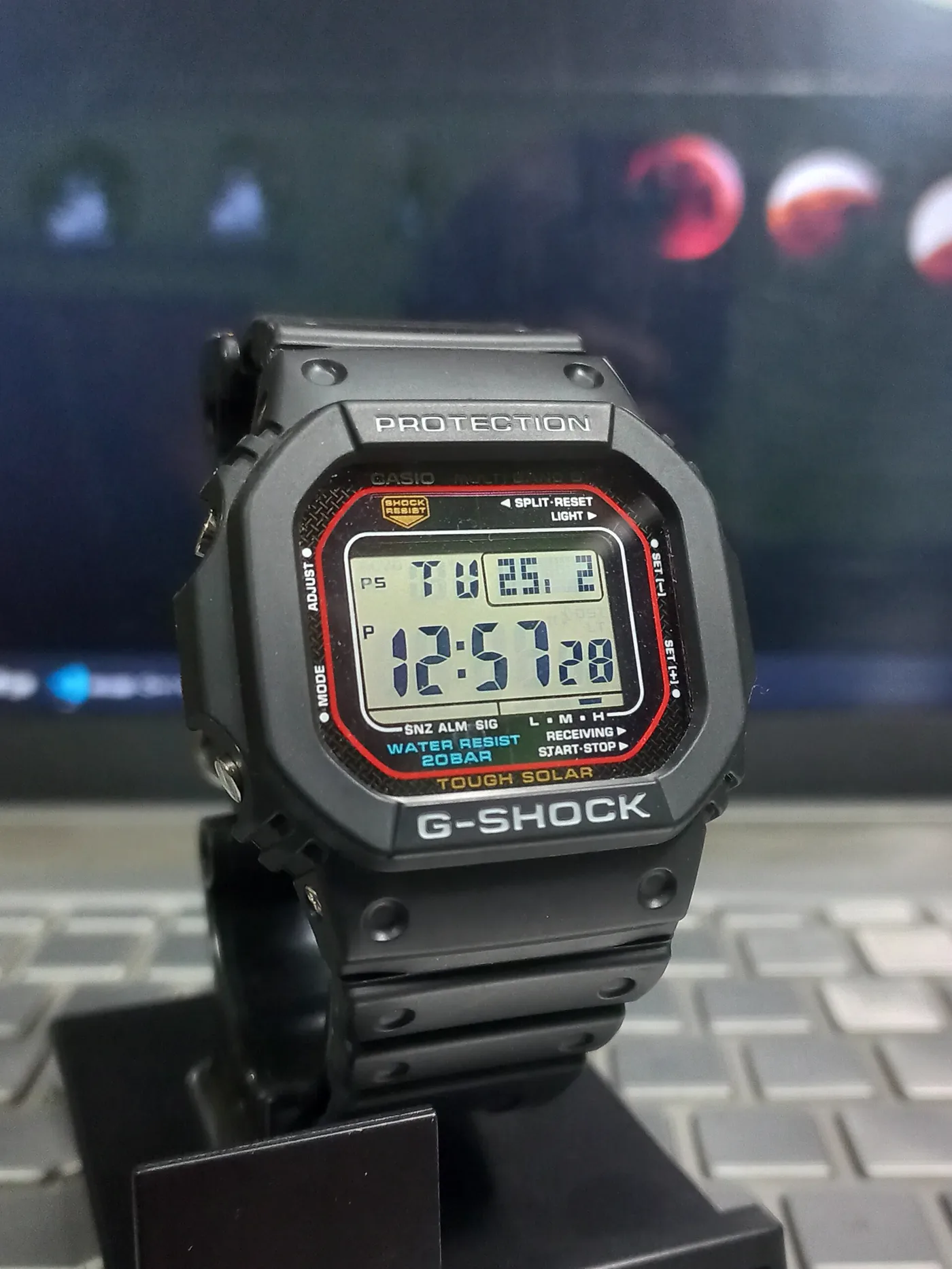
Casio has sold the square G-Shock case since 1983 and still has not found a reason serious enough to retire it. The GW-M5610U is the version that settled the argument for good: a solar cell hidden under the display, a radio receiver that pulls the correct time off an atomic clock signal, and a 43.2mm resin case rated to 200 meters, all of it selling for less than most people spend on dinner for two. Casio does not publish a thickness figure for this reference, and neither will I invent one. Everything else on the sheet is settled, and settled is the point of the watch.
The case for it needs no closing argument
Tough Solar means the cell under the crystal recharges from any light source, sun or a desk lamp, and the movement runs for months from a full charge with no winding required, in Casio’s own words. There is no battery to replace, no service interval to track. Multi-Band 6 means the watch listens for a radio time signal broadcast from six atomic clock stations and corrects itself on its own. You set the time zone once. After that you never touch the buttons again unless you want to check a stopwatch split.
That combination is the entire case, and it does not need help from the rest of the watch to make it. Add a 200 meter water resistance rating and a mineral crystal chosen for impact resistance over sparkle, wrapped around a resin case that has already survived four decades of being dropped down stairs, and you have a watch built to be forgotten about rather than admired. Admiring it is what the rest of this review is for.
The spec sheet reads short, and means it
Read the numbers straight off Casio’s own page and there is not much room for interpretation. 43.2mm wide. 200 meters of water resistance, the depth-rated kind rather than a splash guarantee. Mineral crystal, not sapphire, and that is a real tradeoff rather than a cost-cutting embarrassment: sapphire resists scratches better, but it also shatters more readily under the shock loading a G-Shock case is designed to absorb, so Casio picked the crystal that survives the drop over the one that photographs better in a loupe shot.
The band is resin, molded as one piece with the case, which means there is no such thing as a lug width to measure or a strap to swap. You get the band Casio shipped it with, not a swappable width, since Casio does not publish one for an integrated design. The power reserve is described rather than numbered: solar charged, months of running from a full charge, no winding. That is Casio’s own language, not a hedge on my part, and it means the honest answer to how long it lasts is longer than you will own it before wanting a different watch for a different reason.
What it is not
What Casio has not published, I checked myself before writing a number down. Case thickness is missing from Casio’s own spec page, and the one European retailer I pulled a live listing from today does not even agree with itself: the same page lists the case at both 12.7mm and 13mm. That is a rounding argument rather than a real discrepancy, but it means nobody outside Casio has a confirmed figure, and I would rather leave the cell blank than dress up a guess as a spec.
More to the point, this is not a dress watch and does not want to be mistaken for one. A 43.2mm resin block with a digital display goes with athletic wear and casual clothing and stops there. It will not slide under a cuff the way a thin dress piece does, and no amount of solar charging technology changes that. It is also not automatic, not mechanical, and carries none of the watchmaking romance the rest of this Atlas trades in. If what you want from a watch is the sight of a balance wheel through a case back, this is the wrong entry entirely, and the 18 out of 25 wearability score is the Atlas being honest about exactly that limitation rather than padding a score to match the hype.
So, worth the hype?
Check the current street price and the Atlas band holds. In Europe, one reseller has it listed at 124.79 EUR, discounted off a 199.00 EUR list, which converts comfortably inside the $100 to $150 band the Atlas already called. Casio’s own US product pages and major US retail listings refuse automated verification today, so I am not attaching a specific US dollar figure to this review that I could not independently confirm. Nothing here needs correcting, which is itself worth saying plainly rather than assuming.
At that price the watch earns its 25 out of 25 for value honestly. There is no maintenance cost and no service interval, and nothing near this bracket matches Tough Solar charging with Multi-Band 6 radio sync without charging double for the privilege. The weakness is wearability, and it deserves naming rather than softening: 18 out of 25 is not a bad score, but it is close to the ceiling available to a resin digital case that will never pass for a dress watch, and Casio has made no attempt to change that in over forty years. That reads less like a flaw than a decision, and it is the right one.
If someone handed me $120 and asked for the one watch they would never have to think about again, this is still the answer, and I do not expect that to change before Casio ships the next revision.
Computed from the published formula. See the maths →
TOUGH SOLAR · MULTI-BAND 6
200M WR · MINERAL CRYSTAL
INTEGRATED BAND · NO LUG WIDTH
Retail partners are not live yet. When they are, these become affiliate links. Commissions never touch the score.
- Casio G-SHOCK official site · Case width, Tough Solar charging behaviour, Multi-Band 6 radio sync, mineral crystal and the 200m rating per Casio's published GW-M5610U-1 specification. Casio's US product pages refuse automated requests, so the G-SHOCK brand site is cited instead, matching the Atlas entry's own approach.
- Watches Online (EU reseller), GW-M5610U-1ER · Fetched directly today for a European price check (124.79 EUR, discounted from a 199.00 EUR list) and for case thickness, where the listing itself gives two conflicting figures, 12.7mm and 13mm, on the same page. Casio does not publish a thickness figure for this reference, so neither number is treated as confirmed.
Second opinions.
CREATOR VIDEOS · EMBEDDED WITH FULL CREDITCreator videos appear here as YouTube embeds so every view lands on the creator's own channel. We never re-host or re-cut another reviewer's footage.