Christopher Ward The Twelve:
a better engine, a bigger bill.
Christopher Ward quietly swapped the movement in its best-selling integrated-bracelet watch this year, and the thirty-eight-hour reserve everyone complained about is gone. It did not arrive free.
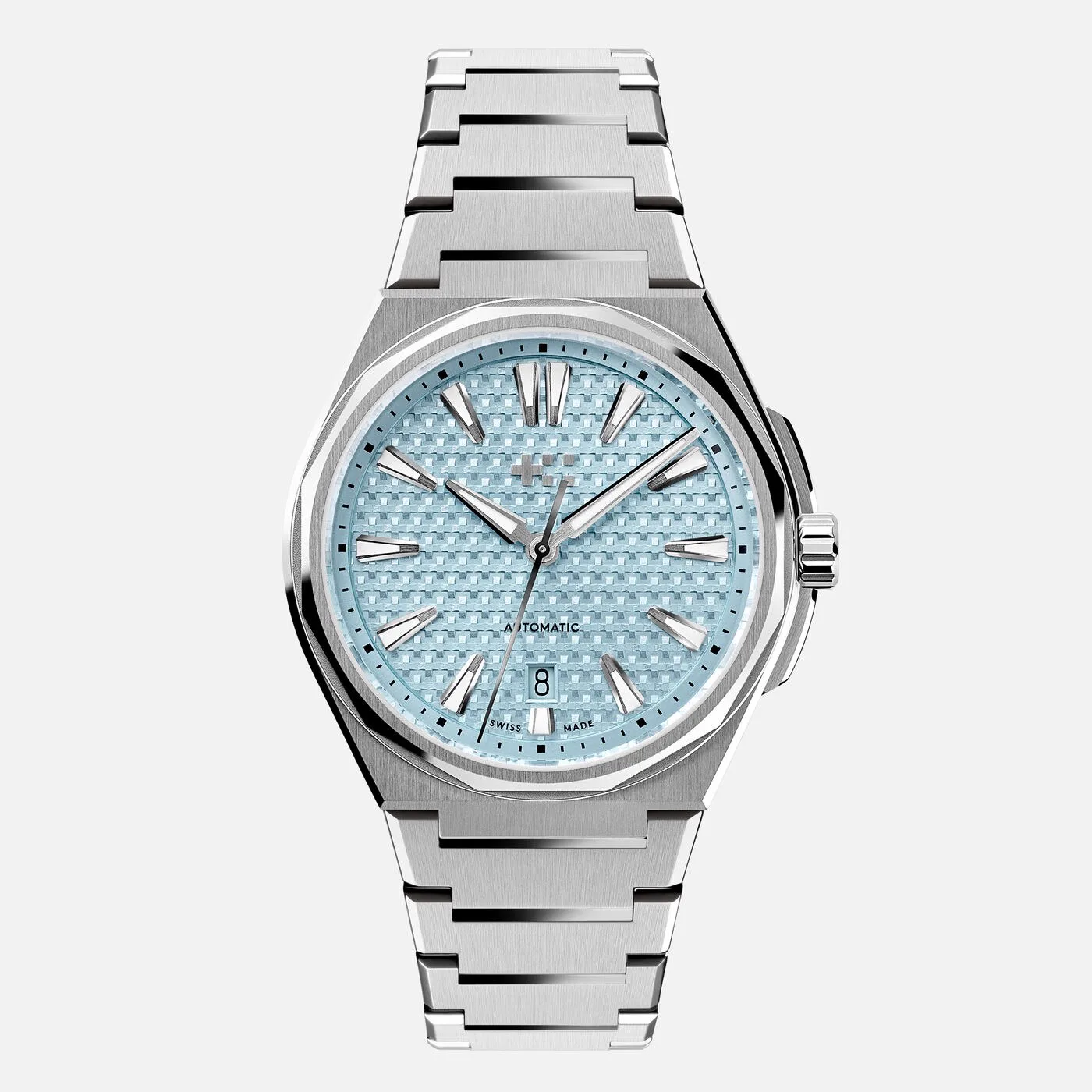
Christopher Ward sells The Twelve as the watch that answers the Tissot PRX on finishing rather than price, and for two years that claim rested on a movement with one obvious soft spot: a Sellita SW200-1 banking a flat 38 hours. Checked against Christopher Ward’s own site today, that watch no longer exists. The Twelve you can order right now runs a Sellita SW200-2 Power+ banking 65 hours, nearly double the old figure, and it costs $1,635 in the 40mm steel configuration, not the $1,150 to $1,395 this site’s own Atlas entry still quotes. This review is about both changes, because neither happened quietly enough to ignore.
The movement finally answers its own reputation
The SW200-2 Power+ is not a new caliber so much as Sellita’s fix for the complaint everyone already had. Christopher Ward’s own copy describes an optimised gear train, a redesigned barrel and mainspring, an enhanced automatic winding system and an updated balance assembly, all stacked into the same architecture that used to tap out at 38 hours. The result, per the maker’s published figures, is a 60-hour minimum reserve with a typical 65 hours, a 26-jewel count, and an accuracy tolerance of -5/+12 seconds a day. None of that makes it a chronometer. It does make it a genuinely different proposition from the watch Christopher Ward was selling in the spring.
The rollout has a paper trail worth knowing. Gear Patrol reported that the SW200-2 Power+ debuted on the C63 Sealander back in April 2026, then spread to the C60 Trident Reef and finally to The Twelve by September. That timing matters for anyone cross-referencing this site: this review’s own Atlas entry is dated 2026-09-07, which means it was very likely written in the narrow window while the old movement and the new one were both still plausible answers to “what’s inside The Twelve.” It is not an error so much as a watch that moved under the page describing it.
Christopher Ward did not just swap the movement and leave it hidden. The Twelve shows it through a sapphire exhibition caseback, with a redesigned rotor that is sandblasted underneath, carries raised branding and a debossed twin-flags logo, and mixes linear brushing on the upper surfaces against concentric circular brushing on the rotor weight. I think that is the right call. A movement upgrade that nobody can see is a spec-sheet improvement. A movement upgrade you can look at through the back of the case is a selling point, and Christopher Ward built it to be looked at.
The rest of the sheet holds, with one honest addition
Strip the movement out of the conversation and the case is the same watch the Atlas entry describes, mostly. It is still 40mm across at 9.95mm thick, which keeps it close to a full millimetre thinner than the Tissot PRX’s 10.9mm, a gap you feel the moment a cuff goes over either watch. Water resistance is still 10 ATM, 100m, and the crystal is still sapphire, confirmed today as anti-reflective on both sides, a small detail the Atlas entry’s plain “Sapphire” line did not capture.
The one real addition is the lug-to-lug figure. Christopher Ward’s Atlas entry calls it “Not published,” reasonably enough for an integrated case with no separate lugs to measure between. The current product page publishes it anyway: 44.5mm, next to a 65g case weight and a 160g total weight with the bracelet on. None of those numbers changes how the watch wears. They do mean the honest-string rule that governs how this site writes about specs now has one less gap to flag on this particular watch, which is a small, genuine improvement in how transparently Christopher Ward sells it.
The clasp is more honest than “three-position” suggested
Here is a correction this review owes its own Atlas entry. The published description calls the bracelet’s adjustment a “toolless three-position micro-adjust clasp,” language that implies three discrete clicks. Christopher Ward’s current copy describes something else: a butterfly clasp fitted with a micro-adjustment mechanism that slides continuously, letting the wearer take up to 1.5mm per side, 3mm in total, rather than snapping between fixed notches. It is still real adjustment and it is still more than the Tissot PRX offers, which is none. It is just not the three-position mechanism the word choice promises, and a review that polices other brands for imprecise specs has no business repeating one of its own.
The bracelet itself tapers from 25mm at the case to 17mm at the clasp, finished with the satin look Christopher Ward gets from a water-grinding process rather than a straight brushed pass, built from single links with screw construction, and ending in a quick-release-compatible fitting that swaps straps without a spring-bar tool. That is a genuinely well-specified bracelet for the price tier. It was already true before the movement upgrade, and it remains the part of this watch that was never the problem.
What the new price actually buys, compared to the old one
Christopher Ward’s own site lists this exact configuration, 40mm, steel bracelet, Glacier Blue dial, at $1,635 today. The Atlas entry on this site still quotes a $1,150 to $1,395 band, written weeks ago and already overtaken. Gear Patrol’s reporting fills the gap: the SW200-2 Power+ rollout came bundled with a flat $140 increase across the lineup, which moved The Twelve’s starting price, its smallest case, cheapest dial and strap combination, to $1,350. The 40mm steel-bracelet build reviewed here sits well above that floor, which puts it somewhere between $240 and $485 past what this site’s own Atlas entry still tells readers to expect.
Set that against the Tissot PRX and the trade gets more interesting rather than less defensible. The PRX Powermatic 80 still runs 40mm at 10.9mm thick, with a Powermatic 80 turning at a slow 21,600vph for a genuinely longer 80-hour reserve, 100m water resistance, sapphire, and a butterfly clasp with no adjustment at all, priced at $650 to $725. When the Atlas entry’s old numbers were current, The Twelve cost roughly double the Tissot for a thinner case, a faster beat and a clasp that actually adjusted, while giving up more than half the power reserve. At $1,635, The Twelve now costs closer to two and a third times the Tissot, while the reserve gap it gives up has shrunk from 80 versus 38 hours to 80 versus 65. Christopher Ward made the trade smaller on the one spec that mattered most and bigger on the one that mattered second most. That is not a contradiction. It is just a more expensive argument than the one this site’s Atlas entry was built to make.
The Seiko Prospex SPB143 is the other number worth sitting with. At $1,200, the price another WatchHypeHQ review confirmed against a dealer listing late last month, the SPB143 undercuts The Twelve by well over $400 at today’s pricing, while clearing a genuine 200m dive rating and banking 70 hours against a 6R35 automatic, a longer reserve than even the new Sellita manages. This site’s own Atlas entry pitched the Seiko as “the same money, in a diver,” a comparison that made sense when The Twelve sat in the $1,150 to $1,395 band. It does not hold anymore. The Twelve has moved into a different price tier than the watch it used to sit next to.
What it is not
The Twelve is not a tool watch, whatever the integrated bracelet’s sporting pretensions suggest. A 100m rating covers swimming and showers, not serious diving, and there is no bezel to time anything with. It is not chronometer-grade either: a -5/+12 second-a-day tolerance is a real improvement over the old movement’s looser spec, but it is an Elaboré-grade Sellita figure, not a COSC certificate, and Christopher Ward does not claim one. It is not an in-house caliber. Sellita built the SW200-2 Power+ and Christopher Ward finished and rebranded the rotor, which is an entirely normal, honest way to build a watch at this price, worth stating plainly because “Power+” branding can read as more proprietary than the base movement actually is. And it is not, anymore, the watch this site’s own Atlas entry describes on paper, which is the whole reason this review exists in its current form rather than a shorter one that just restated the old numbers.
So, worth the hype?
Conditionally, and the condition is specific. Buy The Twelve if the case finishing, the now-genuinely-fixed movement and the detail work on that bracelet are what you are actually paying for, because on those terms Christopher Ward delivered a real upgrade and charged a fair, disclosed amount for it. Do not buy it if the only question on the table is dollars per hour of reserve or dollars per metre of water resistance, because on that math the Tissot PRX still wins outright and the Seiko SPB143 now wins by an even wider margin than it did when this site’s Atlas entry was written. The Twelve earns a Solid buy here on the strength of what changed inside the case. It does not win the argument against either rival on price, and at $1,635 it is no longer close enough to pretend otherwise.
Is there a good Christopher Ward The Twelve review on Reddit?
There is no single Reddit thread this review can point to as the definitive one, and a reviewer who claims otherwise is usually guessing. What the watch forums generally argue about, predictably, is whether the finishing and the new movement justify the price climb, which is the same question this review answers above. For the actual spec changes and the current price, Christopher Ward’s own product page and the reporting cited here are more reliable than forum memory.
Is the Christopher Ward The Twelve worth the money?
Conditionally. At $1,635 for the 40mm steel configuration, checked against Christopher Ward’s own site today, it buys a genuinely upgraded Sellita SW200-2 Power+ with a 65-hour reserve, a thinner case than most rivals in its class, and a well-specified bracelet. It does not buy the best value in its price bracket; the Tissot PRX and Seiko SPB143 both undercut it substantially.
What movement does the Christopher Ward The Twelve use?
A Sellita SW200-2 Power+, automatic, running at 28,800vph with 26 jewels, a 60-hour minimum and 65-hour typical power reserve, and a -5/+12 second-per-day accuracy tolerance, per Christopher Ward’s current published specification. This replaced the original Sellita SW200-1, which banked only 38 hours.
How does the Christopher Ward The Twelve compare to the Tissot PRX Powermatic 80?
The Twelve is thinner (9.95mm against 10.9mm) and now closer on power reserve (65 hours against 80) than it was before the movement upgrade, with a clasp that actually adjusts where the PRX’s does not. It also costs roughly two and a third times as much: $1,635 against the PRX’s $650 to $725.
Does the Christopher Ward The Twelve have a micro-adjust clasp?
Yes, though it is a continuous slide rather than a fixed three-position click as earlier descriptions suggested. Christopher Ward’s butterfly clasp adjusts up to 1.5mm per side, 3mm in total, confirmed on the maker’s own product page.
Computed from the published formula. See the maths →
SW200-2 POWER+ · 65H RESERVE
100M WR · SAPPHIRE AR
INTEGRATED BRACELET · MICRO-ADJUST CLASP
Retail partners are not live yet. When they are, these become affiliate links. Commissions never touch the score.
- Christopher Ward: The Twelve product page (Glacier Blue, 40mm, steel bracelet) · Fetched directly today (2026-10-02). Confirms the Sellita SW200-2 Power+ movement at a 60-hour minimum, 65-hour typical power reserve, 28,800vph, 26 jewels and a -5/+12 second-per-day accuracy; the 40mm case at 9.95mm thick with a 44.5mm lug-to-lug, a 65g case weight and 160g total weight on the bracelet; 10 ATM (100m) water resistance; an anti-reflective sapphire crystal over an exhibition caseback; a bracelet tapering from 25mm to 17mm with a butterfly clasp adjustable up to 1.5mm per side, 3mm total; and the $1,635 price for this configuration. This is the same watch the Atlas entry's product image references, though Christopher Ward has since renumbered the SKU from S00B1 to S00B4.
- Gear Patrol: Christopher Ward's Fan-Favorite Affordable Diver Just Got Even Better · Reports that Christopher Ward introduced the Sellita SW200-2 Power+ on the C63 Sealander in April 2026 and extended it to the C60 Trident Reef and The Twelve by September 2026, replacing a movement with a 38-hour reserve, and that the upgrade came bundled with a $140 price increase, pushing The Twelve's starting price to $1,350 for its smallest configuration. Used for the upgrade timeline and price context in this review.
- Tissot official site (US) · Case dimensions, Powermatic 80 specification, 80-hour reserve and clasp detail for the PRX, used in the comparison section. These figures match the published Tissot PRX Powermatic 80 Atlas entry and review on this site. The direct product URL was not machine-verifiable at build time, so the manufacturer domain is cited instead, the same convention used in the existing PRX review.
- Exquisite Timepieces, Seiko Prospex SPB143 listing · Fetched 2026-09-25 for this site's Traska Freediver review. Lists the SPB143 at $1,200 with a Seiko 6R35 movement, 70-hour power reserve and 200m water resistance, matching the figures in this site's own SPB143 Atlas entry. Used here to show that Christopher Ward's price increase moved The Twelve well clear of the Seiko's price rather than matching it, as this site's Atlas entry assumed when it was written.
Second opinions.
CREATOR VIDEOS · EMBEDDED WITH FULL CREDITCreator videos appear here as YouTube embeds so every view lands on the creator's own channel. We never re-host or re-cut another reviewer's footage.