Grand Seiko SBGA211 Snowflake:
the accuracy is not the argument.
Spring Drive gets you plus or minus 15 seconds a month, a number no conventional mechanical watch at any price in this Atlas can touch. Checked today against two sources, the Snowflake still costs $6,900 for that number, and the honest review is about whether the dial and the clasp justify spending it.
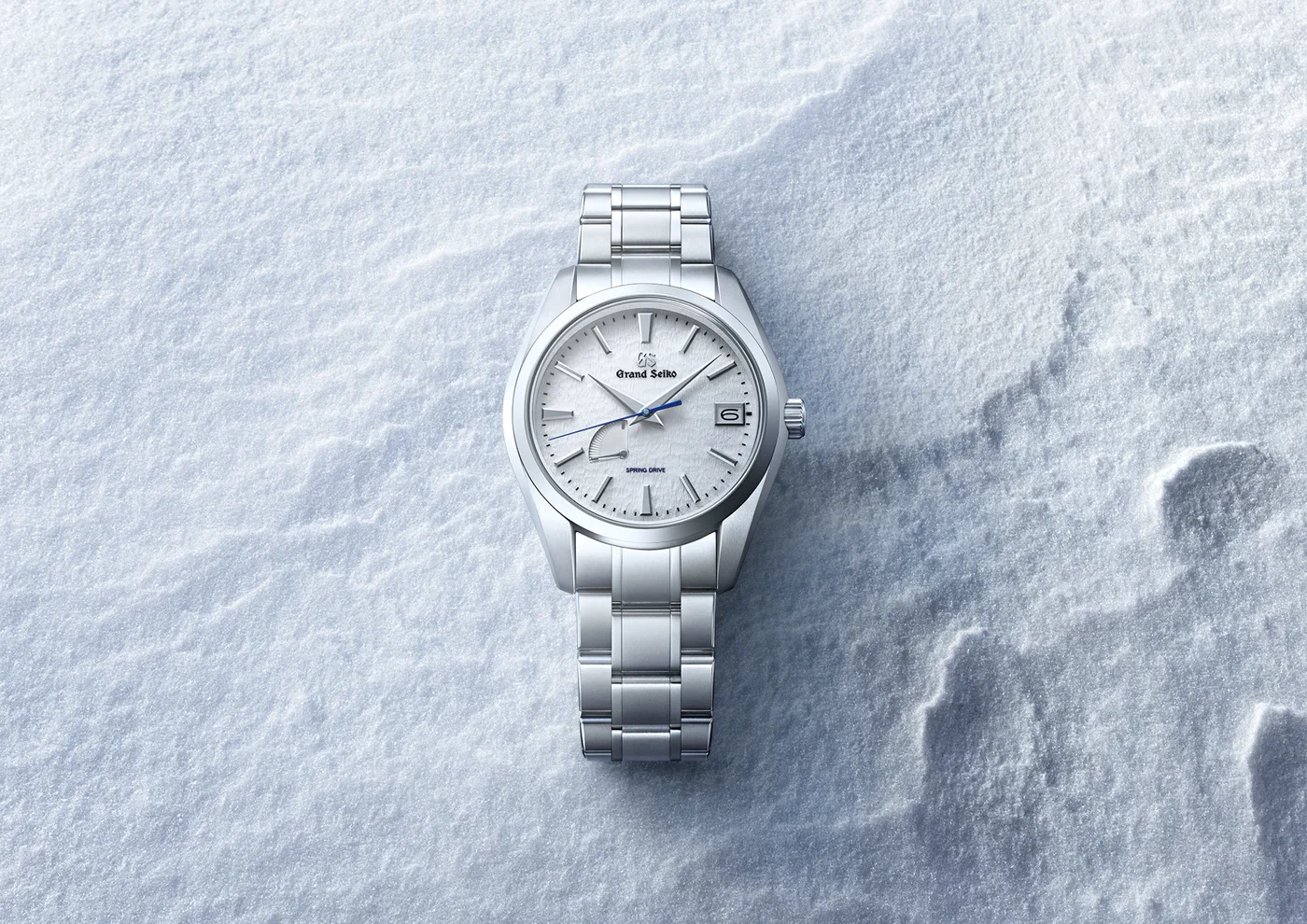
Grand Seiko prints a number on its own spec sheet that nothing else in this Atlas can match: plus or minus 15 seconds a month, roughly a second a day, from a watch that still needs winding down like a mechanical one because in the ways that matter it is one. Checked today against Grand Seiko’s own site and an authorized dealer’s listing, the SBGA211 still costs $6,900 for that number. The accuracy is not in question. Whether it is the thing worth paying for here is.
The case for it is the number Grand Seiko doesn’t flinch from quoting
Spring Drive is the reason to take this watch seriously, and Grand Seiko states the mechanism plainly on its own product page: a conventional mainspring and escapement drive the hands, but a quartz oscillator and an electromagnetic brake regulate the release instead of a lever ticking against a balance wheel. The result is a seconds hand that glides rather than steps, and an accuracy rating of plus or minus 15 seconds a month. No COSC-certified Swiss automatic in this Atlas gets within shouting distance of that figure, including the Rolex Calibre 3230 inside the Submariner 124060, which Rolex regulates to a tighter daily tolerance but still measures in seconds per day rather than seconds per month. No quartz movement here keeps a real, hand-windable power reserve the way the 9R65 does either, at 72 hours. Grand Seiko built a caliber that borrows the best argument from each side of the mechanical-versus-quartz debate and left the compromises on the cutting room floor. That is the single reason the movement sub-score sits at a maximum 25 out of 25, and I would not round it down for anybody.
The case holding that movement is 41.0mm across, 12.5mm thick, with a 49.0mm lug-to-lug and a 20mm lug width, all figures Grand Seiko publishes directly. High-intensity titanium keeps the whole package, case and bracelet together, light on the wrist in a way steel at this diameter simply is not, which is the quiet reason the wearability score lands at 21 rather than lower. A 41mm dress watch with a 49mm lug-to-lug sounds like it should fight a smaller wrist. In titanium it mostly does not.
The dial is the other half of the pitch, and Grand Seiko knows it
The Snowflake earned its nickname honestly. The dial is stamped with a pattern meant to echo wind-carved snow on the Hotaka mountains, finished in a silver-plated texture that catches light differently depending on the angle you tilt your wrist, under dual-curved, AR-coated sapphire rather than a flat crystal sitting on top of it. “SPRING DRIVE” sits printed small at six o’clock, a quiet signature rather than a flourish. This is the part of the watch that photographs for a living, and it is also the part that explains why Grand Seiko can charge dress-watch money for a case this size: nobody else is selling this exact texture, at any price, because nobody else owns the dies that stamp it.
Water resistance is 100 meters off a screw-down crown and case back, which is a real, pressure-tested figure and also not a diver’s rating by any ISO measure. That is fine. This watch has never once been sold as a tool, and treating 100 meters as a shortfall here is the wrong frame entirely. What is a fair complaint: Grand Seiko tells you the bracelet is titanium, 20mm, closed with a folding clasp with push-button release, and then stops talking. Whether that clasp offers any micro-adjustment at all is not stated anywhere in the material the brand publishes for this reference. At $6,900, on a bracelet this central to the watch’s comfort, that is a detail I want printed rather than assumed, and Grand Seiko has had since 2017 to add the sentence and has not.
The price is where the argument against it lives
Here is the number that actually decides this review: $6,900, confirmed directly on Grand Seiko’s own site today and matched by Manfredi Jewels, an authorized dealer, in the same search pass. That sits at the top of the price band this Atlas already had on file, and nothing about it has moved. The value sub-score on this watch is 14 out of 25, the lowest pillar by a wide margin and the one most worth sitting with before you spend the money.
Run the comparison the Atlas entry already set up. A Tudor Black Bay 58 runs $5,225 for the three-link bracelet, on a manufacture MT5400-U movement independently METAS certified, with a clasp that tool-free micro-adjusts, for roughly three quarters of this watch’s price. A Rolex Submariner 124060 runs $10,050 at Rolex’s own retail, about 46 percent more than the Snowflake, and buys a 300-meter dive rating, a Glidelock clasp extension, and resale strength that nothing in this Atlas touches. Both of those watches are spending the buyer’s money on brand weight and bracelet engineering rather than on movement architecture, which is exactly the trade the Atlas entry for this watch already named. The Snowflake spends its money differently: almost entirely inside the case, on a movement and a dial nobody else makes, and almost nothing on the parts of ownership that show up on a resale listing. If what you are buying is a hedge or a status marker in a room full of people who recognize a Submariner on sight, the Rolex and even the Tudor do that job better per dollar. If what you are buying is the most accurate timekeeping a hand-wound mainspring has ever produced, dressed in a dial nobody else can replicate, the Snowflake does that job and nothing else is close.
The cheaper comparison is worth naming too, because it sharpens the question rather than dodging it. Seiko’s own Prospex SPB143 runs $1,100 to $1,200, 40.5mm across and 13.2mm thick, banking 70 hours off a 6R35 automatic that will drift several seconds a day against the Snowflake’s several seconds a month. Both watches carry the Seiko name somewhere on the case back, and the gap between them is almost six thousand dollars for an accuracy improvement measured in single-digit seconds. That gap is not irrational. It is just not about telling time, and anyone buying the Snowflake for the time-telling alone is solving a problem a much cheaper watch already solves well enough.
What it is not
It is not a diver, and the 100-meter rating should not be read as one trying to compete with the Submariner’s 300 meters. That comparison was never the point of this case.
It is not scarce, and it should not carry a waiting-list premium the way the Submariner does. Grand Seiko sells this reference through its own boutiques and a normal authorized-dealer network, at the price printed above, to the next customer who walks in.
It is not transparent about its own clasp. Grand Seiko states the bracelet’s material, width and release mechanism and says nothing about adjustment range, and I am not going to guess at a spec the brand has had nine years to publish and hasn’t.
It is not, finally, a watch that will hold value the way a steel Submariner does. Nothing in the sourcing for this review suggests the Snowflake trades above retail, and a titanium dress watch from a brand still building its resale reputation in the US market is not the place to park money expecting it to grow.
So, worth the hype?
Conditionally, and the condition is specific rather than a hedge. If the thing you actually want is the most accurate hand-wound movement money can buy at any price, wrapped in a dial no other manufacturer owns the tooling to replicate, the Snowflake earns its $6,900 without needing the Grand Seiko name to do any persuading. The movement score is a maximum 25 for a reason, and I would defend that number at a dinner table against anyone who thinks Spring Drive is a marketing term for quartz.
If the question is value measured against a Tudor Black Bay 58 or a Rolex Submariner, two watches that spend the same or more money on bracelet engineering, brand weight and resale strength, the Snowflake loses that argument honestly, and a 14 out of 25 value score says so without me needing to soften it. This is a watch to buy because the movement and the dial mean something to you specifically, not because it is the smartest way to spend $6,900 in this bracket. Those are different reasons to buy a watch, and only one of them holds up here.
Is the Grand Seiko Snowflake worth the money in 2026?
Checked today at $6,900, yes if the Spring Drive movement and the dial are the actual draw. The value sub-score of 14 out of 25 is the lowest pillar on this watch, so the honest answer depends on whether you are buying the accuracy and the craft or shopping it against a Tudor or a Rolex on value terms, where it loses.
What does the online conversation about the Grand Seiko Snowflake focus on?
The recurring threads, wherever enthusiasts gather to argue about this watch, settle on the same handful of questions: whether Spring Drive counts as a “real” mechanical movement, whether the dial’s texture reads as dramatic or subtle depending on the exact lighting a given owner photographed it under, and whether $6,900 is defensible against a Rolex or Tudor at similar money. None of those questions has a universal answer, and this review’s own value score reflects the same tension rather than resolving it for you.
What movement is inside the Grand Seiko SBGA211?
Grand Seiko’s own Caliber 9R65, a Spring Drive movement: a mechanical mainspring and train regulated by a quartz oscillator and electromagnetic brake rather than a lever escapement, rated to plus or minus 15 seconds a month with a 72-hour power reserve and manual winding capability.
How does the Snowflake compare to a Tudor Black Bay 58 or Rolex Submariner?
Both the Black Bay 58 ($5,225) and the Submariner ($10,050) spend their price on manufacture dive-watch engineering, bracelet adjustment systems and resale strength the Snowflake does not match. The Snowflake spends its $6,900 almost entirely on movement accuracy and a dial neither competitor can replicate. Which one is the better buy depends on whether the money is going toward the case or the reputation.
Does the Grand Seiko Snowflake hold its value?
Not in the way a steel Submariner does. Nothing in the sourcing checked for this review shows the SBGA211 trading above its own retail price, and Grand Seiko’s resale market in the US is still younger and thinner than Rolex’s. Buy this watch for the movement and the dial, not as a financial position.
Computed from the published formula. See the maths →
9R65 SPRING DRIVE · 72H
100M WR · SAPPHIRE
TITANIUM BRACELET · PUSH-BUTTON CLASP
Retail partners are not live yet. When they are, these become affiliate links. Commissions never touch the score.
- Grand Seiko: SBGA211 official product page · Fetched directly today. Confirms the 41.0mm by 12.5mm case, 49.0mm lug to lug, Caliber 9R65 Spring Drive movement, 72-hour power reserve, plus or minus 15 seconds a month accuracy rating, 10 bar (100m) water resistance, high-intensity titanium bracelet at 20mm with a folding clasp with push-button release, and the current $6,900 retail price, matching the WatchHypeHQ Atlas entry for this reference exactly.
- Manfredi Jewels: Grand Seiko SBGA211 Heritage Collection listing · Checked via live search today as an authorized Grand Seiko dealer cross-reference. Lists the same $6,900 price and the same case and movement figures as Grand Seiko's own page; the dealer's product page itself returned a rate-limit error to direct automated fetch at the time of writing, so the search index's cached reading of the page is cited rather than claimed as a direct fetch.
- Seiko: Prospex catalogue (generic landing page, no SPB143-specific data) · Fetched directly today. This is a generic catalogue page that does not surface SPB143-specific specifications, so it is cited only as the manufacturer domain for this line. The comparison figures for the SPB143 (case size, thickness, power reserve, price) are not confirmed by this URL directly; they match the WatchHypeHQ Atlas entry for that watch, which sources them to Seiko's own published specification.
- The 1916 Company: Tudor Black Bay 58 listings · Comparison pricing for the Tudor Black Bay 58 three-link (M7939A1A0NU-0002), matching the WatchHypeHQ Atlas entry and review for that watch.
- Crown Watch Group: Rolex Submariner No-Date 124060 price guide · Comparison pricing for the Rolex Submariner 124060, matching the WatchHypeHQ Atlas entry and review for that watch. Used only for the retail figure, not for any Rolex spec.
- Rolex: official Submariner product page · Comparison figure for the Submariner 124060's 300m water resistance rating, matching the WatchHypeHQ Atlas entry and review for that watch. Rolex's site blocks automated verification; both the deep product page and this domain root return 403 to this server, so the manufacturer domain root is cited as the closest verifiable citation, as the Atlas entry for that watch discloses.
- Monochrome Watches: hands-on, Black Bay 58 Black-Gilt (M7939A1A0NU) · Comparison figure for the Tudor Black Bay 58's MT5400-U movement and METAS Master Chronometer certification, matching the WatchHypeHQ Atlas entry and review for that watch.
Second opinions.
CREATOR VIDEOS · EMBEDDED WITH FULL CREDITCreator videos appear here as YouTube embeds so every view lands on the creator's own channel. We never re-host or re-cut another reviewer's footage.