Seagull 1963 chronograph:
the mechanism is the point.
A hand-wound, column-wheel chronograph for $789 is either a pricing error or the best argument in budget watchmaking. Read the sheet before you decide which.
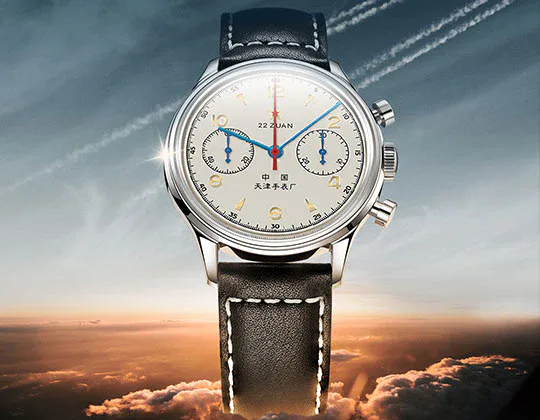
If you search for the Seagull 1963 chronograph, you will find the same watch at wildly different prices, and the gap is the first thing to understand. The version reviewed here is the 40mm Times Edition with a sapphire crystal, and on Seagull’s own store on 2026-10-16 it sold for $789. That sits inside the $749 to $825 band our Atlas entry carries, so nothing has moved. Other variants exist with different case sizes and crystals, and I am not talking about those.
My thesis is simple. This is the watch to buy if you care about what is inside a chronograph more than what is written on the dial. It is also a watch with real limits, and a review that hides them is a brochure.
What a Seagull 1963 chronograph actually is
Most mechanical chronographs under a thousand dollars get there by simplifying the mechanism that starts, stops and resets the timing. Seagull did not. The movement is the ST1901, manual winding, column wheel chronograph, per Seagull’s product page. It carries 22 jewels and beats at 21,600vph, both stated on that same page. The dial prints “22 ZUAN” to say as much, a marking the authenticity guide walks through.
Why does a column wheel matter? Because it is the part enthusiasts argue about, and because it is usually the part a cheaper chronograph leaves out. The Omega Speedmaster Professional, the manual chronograph everyone measures against, costs a multiple of this watch. Our Atlas entry notes it uses a cam rather than a column wheel. I am not going to tell you a cam is bad. I am going to point out that you can own the more admired mechanism for $789.
The lineage is the other half of the pitch. The 1963 name points to the aviation chronograph that Tianjin built in that year, and the brand’s heritage claim is something the Atlas entry cites. I treat it as heritage and nothing grander. A reissue is a reissue. What counts is whether the thing in your hand works the way the story says.
The spec sheet read, line by line
Start with the case. It measures 40mm across, 14.5mm thick, and 46.8mm lug to lug, with a 20mm lug width, all from the product page. Those are not small numbers together. A 14.5mm case is a tall one, and a hand-wound chronograph with a domed sapphire crystal will sit on top of the wrist rather than under a cuff. The 46.8mm lug to lug is the number I would watch if your wrist is slim. At 40mm diameter the watch reads as moderate, and the lug to lug keeps it from feeling oversized, but the height is what you will notice at the end of a long day.
The 20mm lug width is the underrated kindness here. It is the most common strap size there is, so the strap drawer you already own probably fits.
Now the movement figures. Twenty two jewels and 21,600vph are the headline, but the honest complication is the power reserve. Seagull’s marketing copy says approximately 45 hours. Its FAQ says 40 to 42 hours. The maker contradicts itself on one page, so I will not pick a winner for you. Plan on the lower figure and treat anything more as a bonus. For a hand-wound watch that is a gentle compromise: wind it every other morning and it never stops, and wind it only when you remember and it will.
Water resistance is 3 Bar, 30 meters, per the same source. This is rain and handwashing. It is not a pool, and the lack of a screw-down crown tells you not to try. The crystal is sapphire, which is where Seagull spent money that the water rating did not need.
Then the strap. Seagull offers leather or NATO, 20mm, on a pin buckle. There is no bracelet at all. If you were hoping to turn this into a steel-on-steel everyday watch, you cannot do it from the manufacturer’s range, and aftermarket bracelets for a chronograph with this case shape are a project, not a purchase.
How the dial reads
The layout puts running seconds at 9 o’clock and a 30 minute counter at 3 o’clock, with a tachymeter on the outer track, all described in the authenticity guide. Two sub-dials rather than three keeps the face open and legible, and the cream colour the Atlas entry shows suits the vintage intent. I like this restraint. A chronograph that crowds its dial to look busy is a worse tool than one that leaves room to read.
The tachymeter is decoration for most owners. Nobody times a mile to compute average speed anymore. I mention it because it is there, and because it is part of what you are paying for in character.
Where the money goes and where it does not
A $789 chronograph is a statement about priorities. Seagull put the budget into the movement and the sapphire. It did not put it into finishing, into a bracelet, or into water resistance. I think that is the right order, and it is also the order that will annoy some buyers.
The Atlas entry records that finishing is honest rather than exceptional and that fit varies between individual watches. I cannot verify that variation from a spec sheet, and I have not handled the watch, so I will say only what the pattern implies: at this price, buy from a seller with a straightforward return policy and inspect the chronograph pushers and the alignment of the subdials when it arrives.
The service question is the one the product page does not answer, and the Atlas entry says the network runs through Tianjin. If you value being able to walk into a boutique, this watch does not offer it. If you are the sort of owner who treats a hand-wound watch as something to enjoy and replace if it dies, the calculus is different.
What the Seagull 1963 is not
It is not a diver. 30 meters, full stop.
It is not a thin dress chronograph. At 14.5mm thick, it asks for a looser sleeve than the average wristwatch.
It is not a Swiss watch with a Swiss watch’s finish. Anyone who tells you the polish matches a Speedmaster is selling something.
It is not a bracelet watch, and it will not become one without effort.
And it is not a long reserve watch, however the marketing reads. The 40 to 42 hours in the FAQ is the number to trust.
The case for it, restated
Set those limits beside the price. For $789 you get a hand-wound column wheel chronograph, a sapphire crystal, two straps in the box according to the product page, and a dial that reads cleanly. In my judgment the column wheel at this price is the real draw. That is the whole case, and I think it is strong enough to carry the watch.
The HypeScore reflects it. The movement earns 21 out of 25 for the mechanism and the hand-wound honesty, held back from more by the contradictory reserve claim. Build gets 18, the lowest of the four, because 30 meters, variable fit and plain finishing are real costs. Value is 23, the highest, because the price against the mechanism is the reason to buy. Wearability sits at 20: a standard lug width and a moderate diameter, offset by that height. The total is 82 out of 100, which puts it in Hidden gem territory.
So, worth the hype?
Yes, with the condition stated plainly. The hype around this watch is that you can get a column wheel chronograph for under $800, and that is true. The hype does not say that the case is tall, that the water resistance is minimal, or that the maker quotes two different reserves. Those are the costs, and they are all printed on the sheet if you read it.
If I were choosing at this price, I would pick the Seagull for the mechanism and accept the case. If you want a watch that feels finished in the hand and survives a swim, the answer is a different watch, and the Seiko Prospex SPB143 in our Atlas is the step up in fit and finish. If you want the cheapest honest mechanical watch with no chronograph at all, look at the Hamilton Khaki Field Mechanical. But if a column wheel is what you are after, this is the one, and I would not look further at $789.
Seagull 1963 chronograph questions, answered
How much is the Seagull 1963 chronograph? The 40mm Times Edition sold for $789 on Seagull’s official store on 2026-10-16, inside our $749 to $825 band. Other variants with different cases and crystals are different watches.
What movement does the Seagull 1963 use? The ST1901, a manual winding, column wheel chronograph with 22 jewels and a 21,600vph beat rate. It has no automatic winding, so you wind it by hand.
How long does it run on a full wind? Seagull states approximately 45 hours in its marketing copy and 40 to 42 hours in its FAQ. I would plan on the lower figure.
Is the Seagull 1963 water resistant enough for swimming? No. It is rated 3 Bar, 30 meters, which covers splashes and rain, not immersion.
Does it come on a bracelet? No. Seagull offers a leather or NATO strap on a pin buckle, 20mm wide, and no bracelet option.
Computed from the published formula. See the maths →
ST1901 · COLUMN WHEEL · HAND-WOUND
3 BAR · SAPPHIRE
LEATHER OR NATO · NO BRACELET
Retail partners are not live yet. When they are, these become affiliate links. Commissions never touch the score.
- Seagull: 1963 Chronograph Original Times Edition product page · Case size, thickness, movement, jewel count, beat rate, crystal, water resistance, both power reserve figures, and the $789 price re-checked on 2026-10-16.
- Seagull: 1963 Chronograph authenticity guide · Dial layout and the 22 ZUAN jewel count marking.
- Seagull official site · Establishes the manufacturer domain, as distinct from the lookalike storefronts selling under the same name.
Second opinions.
CREATOR VIDEOS · EMBEDDED WITH FULL CREDITCreator videos appear here as YouTube embeds so every view lands on the creator's own channel. We never re-host or re-cut another reviewer's footage.