Ask a room of watch people about Chinese brands and you get two speeches. One says the spec sheets are fantasy and the movements are lottery tickets. The other says the established names have been coasting on heritage while these brands sell similar movements for a third of the money. Both speeches skip the useful part, which is that “Chinese microbrand” is not a quality grade. It is a description of where a company says it is and how it sells. Whether the watch is any good is a separate question, and the spec sheet is where you answer it.
This guide is built on that separation. Every pick here carries a documented origin in our atlas, cited to a page the brand itself publishes: a street address in Dongguan, a pair of offices in Hong Kong and Shenzhen, a registered trade name in Guangzhou, a factory heritage in Tianjin. Every pick also carries a named sales channel. Where a brand does not publish an origin, we make no claim about it, however obvious the guess might be. That is why the list is five watches and not twelve: plenty of affordable brands in the atlas have clean spec sheets and no documented origin, and they belong in other guides.
What the paper trail actually tells you
Start with what an origin note is worth. Not much, on its own. A published address tells you there is a physical company that has put its location where a customer can find it. It does not tell you about service, QC or whether the watch arrives with the crown aligned. What it does is move the brand from anonymous to accountable. A brand that prints a Dongguan address on its store site, or a Hong Kong and Shenzhen office list on its about page, has given you something to point at if an order goes wrong.
The sales channel matters more than the origin. All five picks sell through a brand-run store, and Seestern additionally declares an official AliExpress store on its own site. Seagull’s official statement names en.seagullwatch.com as one of only two official Seagull domains, which is a warning as much as a convenience: the same page exists because lookalike storefronts trade on the Seagull name. San Martin does something similar from the other direction, running several regional storefronts under different domains. The atlas cites different San Martin domains for different references. If you buy from a brand like this, buy from the domain the brand itself points to, and read the spec sheet on the page where you are paying.
Reading the spec sheet when the brand is quiet
The first discipline is to separate what is published from what is implied. The atlas marks each missing figure as exactly that: not published in our verified source set. On this list those gaps fall in predictable places.
Power reserve is the commonest. San Martin does not publish one for the NH35 in the SN0121T. Pagani Design does for the PD-1661 (41 hours), and Seestern does for the S434 (41 hours), and Baltany says more than 42 hours in its own wording. A missing power reserve does not mean the number is bad. It means you are being asked to assume it, and the right assumption for an automatic movement is the family figure, not the best case.
Accuracy is the second gap. None of our five publishes a daily rate, and we print none. If you care about rate, the honest position is that you will find out by wearing the watch for a week, and that regulating a movement is a job for a watchmaker, not a spec sheet. The Seagull is a hand-wound chronograph and its page publishes beat rate and winding type, but still no rate figure.
Lug-to-lug is the third, and it is the one that costs people real money. Case diameter is how a watch is sold. Lug-to-lug is how it fits. Seagull publishes 46.8mm, San Martin 47mm, Baltany 43.3mm. Seestern and Pagani Design do not publish one for the S434 and PD-1661, so you are buying a 39mm and a 40mm watch whose true footprint you cannot check. Thickness helps. The Seestern S434 is 10mm in the case but 13mm over the crystal, and the Pagani PD-1661 is 13mm, so neither is a slim watch whatever the diameter suggests.
The fourth, and the one to learn to read, is the water-resistance line. A bare rating like “200m” is a number the brand wrote down. A rating with an ISO Diver’s certification is a number a standard tested. The atlas keeps the distinction. Baltany lists 200m and says explicitly that it states no ISO or Diver’s certification. The Citizen Promaster NY0086 in our atlas, by comparison, is listed as ISO-compliant Diver’s. We are not saying the Baltany leaks. We are saying the page does not claim a standard, and neither should you.
Related: when two pages from the same company disagree, the atlas reports the disagreement and does not pick a winner. The Seestern S456 GMT is listed at 200m on one Sugess storefront and 100m on another, and we treat it as unconfirmed. The Seagull does the same thing with power reserve: 40 to 42 hours in the FAQ, approximately 45 in the marketing copy. Companies that publish two numbers have handed you a free lesson in which one to trust. Use the conservative one.
What the money buys
Prices on this list run from $133 to $825, which is a wide range, so it is worth being plain about what each step buys.
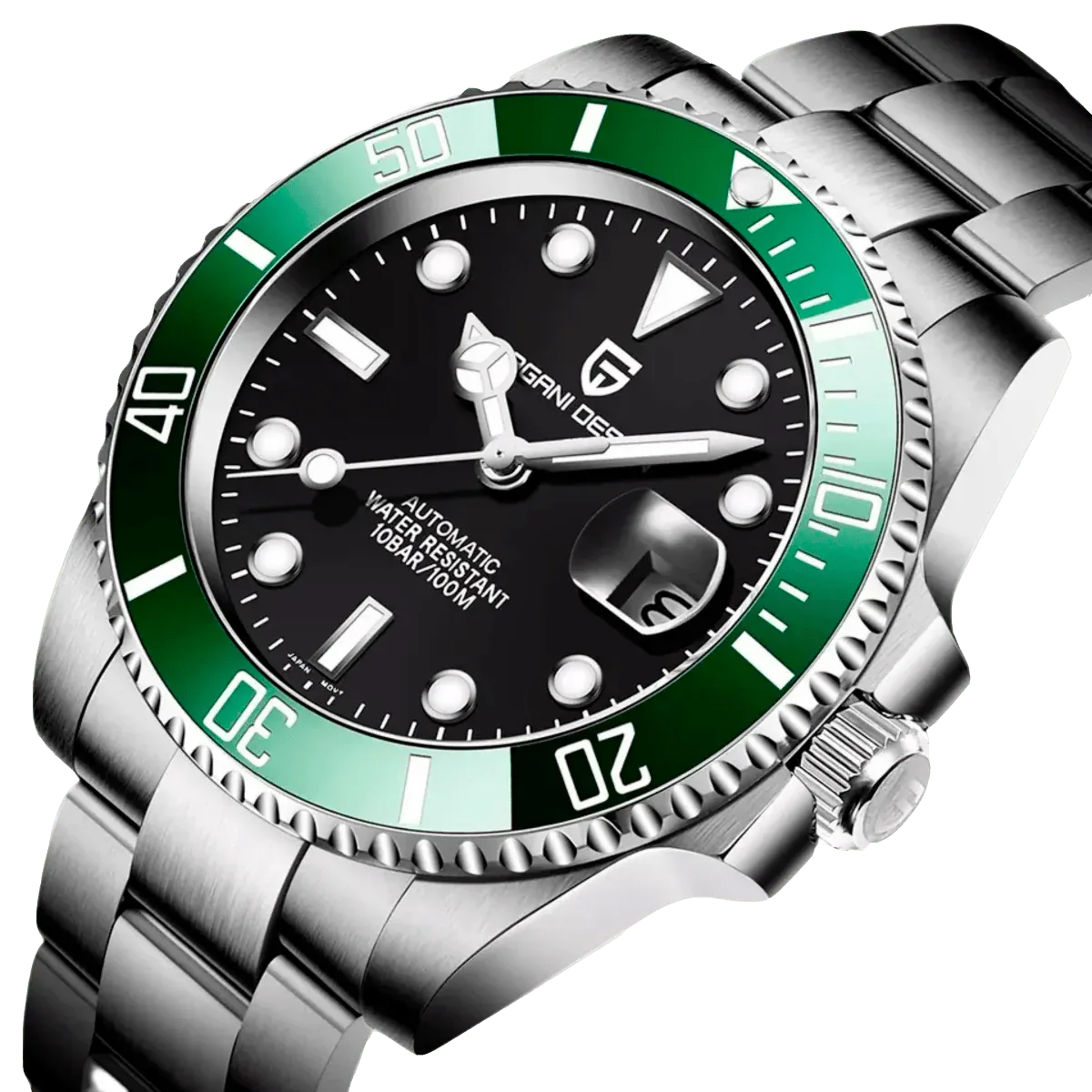
At the bottom, the Pagani Design PD-1661 at $133 to $139 buys a Miyota 8215, a sapphire crystal, a 20mm lug width and a choice of leather strap, Oyster bracelet or Jubilee bracelet. It scores 70 overall, with 14 on movement, 16 on build, 21 on value and 19 on wearability. That is a perfectly reasonable score for a watch that costs what it costs, and it is also the lowest score here. Do not buy it expecting the watch above it.
The $190 to $230 Seestern S434 is the first step up, and what it adds is a movement with more documented behaviour: an NH35A with 21 jewels, hacking and hand-winding, a stated 41-hour reserve. Its hypescore is 74. The movement and build subscores are 17 each, wearability is 19, value 21.
Then there is a plateau. The Baltany at $300 to $340 scores 80, the San Martin SN0121T at $265 to $295 scores 81, and the Seagull at $749 to $825 scores 82. Three watches within two points of each other across a price range of more than double. That is the single most useful thing about this list: the score does not climb with the price. The Seagull’s extra money is buying a different kind of watch, a hand-wound column-wheel chronograph, not a better version of a three-hander. If you do not want a chronograph, the Seagull’s premium buys you nothing you asked for.
A useful comparison sits outside the list. The Miyota 9039 in the Baltany at $300 to $340 is also the movement in the Baltic Aquascaphe Classic at $735, and in the Traska Freediver at $685 to $735. Same movement name, three different cases, three different prices. The higher-priced watches score 77 and 86 respectively, against the Baltany’s 80. We make no claim about origin for either, since the atlas carries none, and we do not suggest the cases are interchangeable. The point is narrower: a movement name tells you less about the price than you might think, and the case, bracelet and finishing carry the difference.
How the score is built
Hypescore is four sub-scores added together: movement, build, value and wearability. On this list the movement sub-score ranges from 14 to 21, build from 16 to 21, value from 20 to 23, and wearability from 16 to 23. The Seagull gets its lead from a movement score of 21, the top of the five, and from the 23 it earns on value. The San Martin’s 81 leans on build, where the titanium bracelet helps, and on wearability, where the 39mm and 47mm lug to lug do the work. The Baltany’s 80 leans on a value score of 22 and on a 36mm case that is 8.9mm thick with a 43.3mm lug to lug.
Note what the score does not contain. It has no origin term and no brand-prestige term. Every watch in the atlas is scored on the same four things, and the table makes the point. The Citizen Tsuyosa scores 77 at $371 to $495. The Seiko 5 Sports SRPD55 scores 80 at $280 to $350. Both sit inside the range of this list. What changes at the top of the atlas is movement and build, which reach into the 20s, and value, which drops into the teens.
What to skip, and why
Skipping is where this category is easiest to get wrong, because the product pages are good at hiding the reasons.
Skip the Pagani Design PD-1752 if you have a normal wrist. It is a 36mm dress watch that is 14mm thick, a proportion that is hard to wear however it photographs, and its wearability score is 16, the lowest of any watch discussed here. Its movement is a Seagull ST16, 40-hour reserve, and the page does not publish a lug-to-lug figure. The PD-1671 at $175 to $190 is a 42mm diver that is 14mm thick, on a 21mm lug width that narrows your strap options, and it scores 68. If you want Pagani Design at all, the PD-1661 is the more sensible shape.
Skip the Steeldive and Cronos listings if origin is the point of your search. They are good-value watches in the atlas, and Steeldive does carry a sales channel, but neither carries a documented origin, so they cannot appear in a guide about where a brand says it is from. That is a limit of this guide, not a verdict on them.
Skip the San Martin SN0055-G if you want a bracelet. It comes on a leather strap only, with no steel option, and its page offers a choice of PT5000, ST2130 or SW200 movement grades, with production moving from the PT5000 toward the ST2130. A listing that changes what is inside it is a listing you should re-read before you pay. It scores 75.
Skip anything priced as if it were a mystery. If a Chinese-brand listing cannot tell you its case thickness, its lug width, its crystal and its water rating, you have been handed a photograph and not a watch. Every pick here publishes at least some of these figures and says what is missing.
Who should buy which
If you want a hand-wound chronograph and are happy to pay $749 to $825 for it, buy the Seagull, and read the catch about the 30m rating first. If you want one watch that goes in the water, buy the San Martin SN0121T: it is 300m, titanium, 39mm, and it is the only diver on the list with a published sale price against a regular price. If your wrist is small, the Baltany is the answer, at 36mm and 8.9mm thick. If you want the cleanest documented sales channel in the cheap range, the Seestern names its offices and its AliExpress store on its own site. If you want to spend $133 to find out whether you even like automatics, the Pagani Design PD-1661 is a decent place to learn, and a poor place to stop.
And if the question that brought you here was whether it is safe to buy from a Chinese brand at all, the useful answer is smaller than the question. It is safe to buy from a brand that publishes where it is, what it sells, where it sells it and what its watch is made of, and it is unwise to buy from one that does not. That test applies to every watch in the atlas, from the $18 Casio to the $14,500 Rolex, and it is the only one we apply here.
This guide launches with five picks and grows to eight. The gaps are not hidden: where a brand has no documented origin, it is not in the guide. Five watches we can cite line by line beat eight we cannot.