Most advice about small wrists starts and ends with case diameter. Buy a 36mm watch, the advice says, and you are done. That is half true, and the half that is missing is the half that causes returns. Diameter tells you how much dial you get. It does not tell you whether the lugs stop where your wrist stops, and it says nothing about how far the case stands off your skin. Those two answers live in two other numbers, lug-to-lug length and thickness, and this guide ranks watches by them first.
The picks are five, not eight, because only a handful of watches in our inventory publish all the dimensions needed to judge fit. Where a brand leaves a figure out, we say so under the pick and do not fill the gap.
What the diameter hides
Start with an example from our own inventory. The Baltany S4015A is a 36mm case with a 43.3mm lug-to-lug. The Cronos L6019 is also 36mm, with a 43.4mm lug-to-lug. Those two are close cousins on paper. Now look at the San Martin SN0138-G: a 37mm case and a 45.5mm lug-to-lug. One millimetre of diameter turned into more than two millimetres of length, because the lugs on that case are longer relative to the body.
Go the other way and the gap widens. The San Martin SN0121GA is a 39mm case with a 47mm lug-to-lug. The Baltic Aquascaphe Classic is also 39mm, also 47mm lug-to-lug. The Cronos L6005 is 40mm with a 47.8mm lug-to-lug. Each of those is a perfectly good watch, and each is a poor fit for the wrist this guide is about, because the length climbs past 47mm while the diameter still sounds modest.
The most extreme case in the inventory is the Steeldive SD1975. Its case is 47.5mm without the crown, and its lug-to-lug is 44mm. A short lug-to-lug on a very large case is a reminder that a single figure is never enough. At 15mm thick with 22mm lugs, it is not a small-wrist watch by any measure we would stand behind.
So the first rule of reading a spec sheet for this category is to find lug-to-lug before anything else. If the brand does not publish it, treat the watch as unknown until you have seen it on a wrist. Several brands in our inventory do not publish it, including Timex, Orient for the Bambino 38, Tissot for the Gentleman, and Hamilton for the Khaki Field Mechanical. We do not penalise them in the ranking, but we do not recommend them blind either.
Thickness is the second number
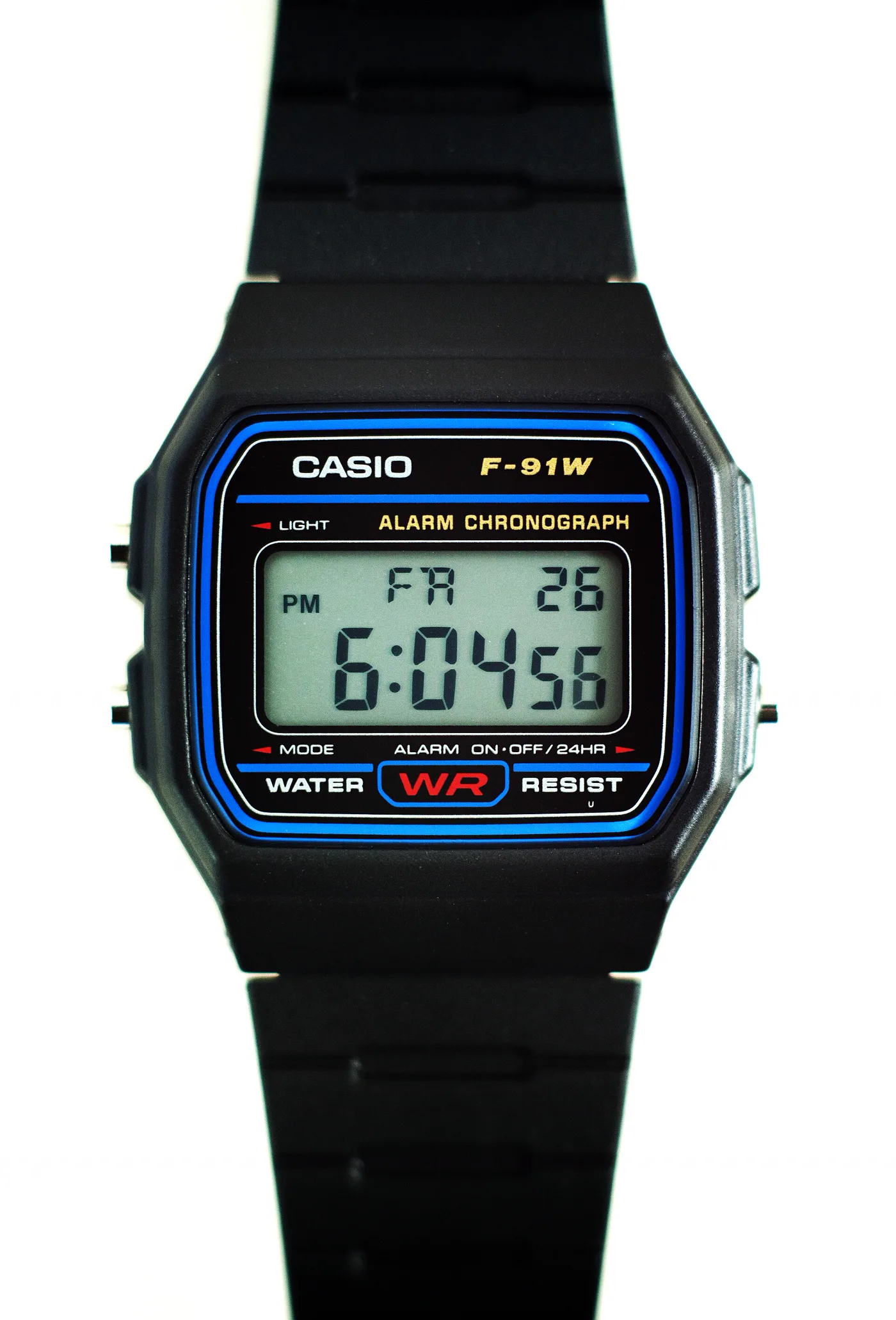
The second measurement is height. A thin case slides under a cuff and sits flat. A thick one rocks. On our list, the Casio F-91W is 8.5mm and the Baltany is 8.9mm. The Timex Marlin is 10mm. The Cronos is 11.55mm. The San Martin SN0138-G is 12.7mm.
The Baltany sheet has a wrinkle worth reading carefully. Its 8.9mm is the case, and the thickness including the glass is 10.9mm. Baltany prints both, which is the honest way to do it, and the second figure is the one that sits on your wrist. Most brands print one number and leave you to guess which kind it is. Lorier prints both, as did Baltic and Traska: the Traska Freediver is 10.5mm for the case and 11.9mm with the box sapphire dome. When a brand prints two thicknesses, use the larger.
Then there are watches that print an impressive-looking thickness that is not the whole story. The Seestern S434 is 10mm thick, but that is 13mm over the crystal. The Pagani Design PD-1752 is 36mm across, which sounds ideal, and 14mm thick, which does not. That is a lot of height for a 36mm case, and it is the reason the PD-1752 is not in the picks. It is the clearest example in the inventory of a diameter that flatters a watch.
What small cases give up
Small and thin cases cost something, and the sheet is where you see it.
The first cost is water resistance. The thinnest watches here carry the lowest ratings: 30m on the Casio and the Timex. That is the printed rating and we leave it there. The Baltany lists 200m, but Baltany states no ISO or Diver’s certification, so that figure is a listing, not a certification. The San Martin carries 200m and the Cronos 100m. Read the number against what you plan to do and do not read more into it than the brand prints.
The second cost is movement. The thin Baltany uses a Miyota 9039. The Timex uses a hand-wound mechanical movement and Timex does not name the caliber. The Casio is quartz. Each is a trade, and the trade is worth knowing before you buy.
The third cost is the crystal. On a thin case, a crystal is either flat and thin or domed and tall. The Cronos has a flat sapphire. The Baltany has a domed sapphire and says so. The Timex has a domed acrylic crystal. The Orient Bambino 38 has a domed mineral. Each domed choice adds height and character at once, and each flat one gives up some of both.
Why the strap matters more than usual
Lug width is the quiet spec on small wrists. The Casio tapers from 18mm at the lugs to 22mm at the buckle, per our inventory. The Timex and the Baltany both use 18mm straps. The Cronos and the San Martin use 20mm lugs. Narrower lugs and straps look in proportion on a small case, and the 18mm pair are the two on this list that do.
Bracelets are the next question. The San Martin SN0138-G has a three-link 316L bracelet that tapers from 20mm to 16mm with an extension folding clasp. The Cronos comes on brushed stainless steel, but Cronos does not itemize the clasp or the link style, so we say only that it is brushed stainless. A bracelet adds length and weight, and a small wrist feels both. Compare the printed lug-to-lug and thickness on a strap model with the bracelet before you assume they fit alike; the inventory does not say how much length a bracelet adds.
Reading the budget
The cheapest honest answer to this guide is the Casio F-91W at $18-25. Its lug-to-lug is the shortest on the list at 38.2mm, and it is the only quartz piece here. The rest of the range sits between $205 and $340: the Cronos at $205-248, the San Martin at $218-238, the Timex at $239-259 and the Baltany at $300-340.
Value per dollar in this group is led by the two NH35 divers, but the Baltany brings the one thing the others cannot, a short, thin case with a sapphire crystal and a Miyota 9039. That is why it ranks first at 80 on the hypescore, level with the San Martin on score and ahead of it on fit. The San Martin takes second because the hypescore ties and the 12.7mm height does not.
The splurge, and why it is not a pick
One watch in the inventory is made for a small wrist by almost any reading: the Tank Must de Cartier. Its case is 33.7mm by 25.5mm and 6.6mm thick, the thinnest figure in our inventory. It runs on a SolarBeat photovoltaic quartz movement, with about 24 months of autonomy per full charge on the current version and a battery unit rated for 16+ years. The price is $3,900 and the hypescore is 71.
It is not in the picks because the ranking is built on value as well as fit, and the value score of 13 is the lowest in the inventory. It also publishes no lug width, no lug-to-lug, and no crystal material beyond calling it square-shaped glass. If the budget is not the question, it deserves a try-on. If the budget is the question, the Timex Marlin gives you the other side of the same idea, a small, plain dress watch, at about a fifteenth of the cost.
What to skip
Skip anything over 47mm lug-to-lug unless you have tried it on. In our inventory that includes the Baltic Aquascaphe line at 47mm, the Traska Freediver at 48mm, the Seestern S456 GMT at 48.8mm, and the Casio G-Shock GA-2100 at 48.5mm. The Steeldive SD1969 prints 56mm including the crown, 48mm lug-to-lug and 15.6mm thick. Those are fine watches for someone else.
Skip the 14mm-thick “small” watch. The Pagani PD-1752 and the Pagani PD-1661 both measure 13mm or more, and a short diameter does not rescue that. Skip the Lorier Neptune Series IV, which on paper is a 39mm diver, because our sources show it has been discontinued and replaced by a different generation.
Skip the Swatch Sistem51 for this purpose, not because it is a bad watch, but because Swatch does not publish a case size, thickness, lug-to-lug or lug width in our verified source set, and a guide about fit cannot rank a watch with no fit data. The same goes, to a lesser degree, for the Hamilton Khaki Field Mechanical. It is 38mm with 20mm lugs, but Hamilton publishes neither thickness nor lug-to-lug.
How we ordered the five
The Baltany is first because it has the shortest lug-to-lug of the three watches with an automatic movement and a sapphire crystal, and it publishes thickness both ways. The San Martin is second as the only diver in the group. The Cronos is third on price, with the sold-out note attached. The Timex is fourth as the smallest mechanical watch. The Casio is last on score and first on footprint, which is why it holds the award it does.
If you take one habit away, make it this: before buying, write down the lug-to-lug and the thickness, in that order, and compare them to a watch you already wear comfortably. A diameter of 36mm and a diameter of 37mm are not the same size in any way that matters, and the sheet tells you so if you read the second and third lines.
This guide launches with five picks and grows to eight. We would rather list five watches whose dimensions we can cite than eight we cannot.